There is something indescribably and undeniably bittersweet about fall. Indeed, this reaction to autumn seems to be a universal feeling in many cultures around the world. Arguably no other culture embodies this melancholy beauty better than Japan. They even have a name for it: mono no aware (Mono = thing, No=of and Aware=sadness). This word is used to describe the traditional Japanese idiom that translates to “the pathos of things” (“pathos” being a quality in art, writing or life that evokes feelings of sadness, pity or sympathy.) At its core, mono no aware celebrates the bittersweet awareness of impermanence that fall, more than any other season, evokes. Indeed, the shortness of this season is the reason for its particular sweetness.
Mono No Aware
It’s interesting that our English word “aware” and the actual Japanese word “aware” (pronounced “ah-wah-RAY”) have the same spelling and even similar meanings. The Japanese version of the word translates roughly to “pathos,” “deep feeling,” “sensitivity,” or a gentle, bittersweet sadness. It was originally used as an exclamation—similar to saying “ah,” “oh,” or “wow” when struck by the beauty of something. Similarly, the definition of the English word “aware” is an adjective that means having knowledge, understanding, or realization of something. However, the significant difference between the two is the emphasis on psychological feeling and connection that the Japanese meaning of aware embodies. By contrast the English version of this word seems more concerned with the somewhat sterile definition of knowing something as opposed to feeling it.
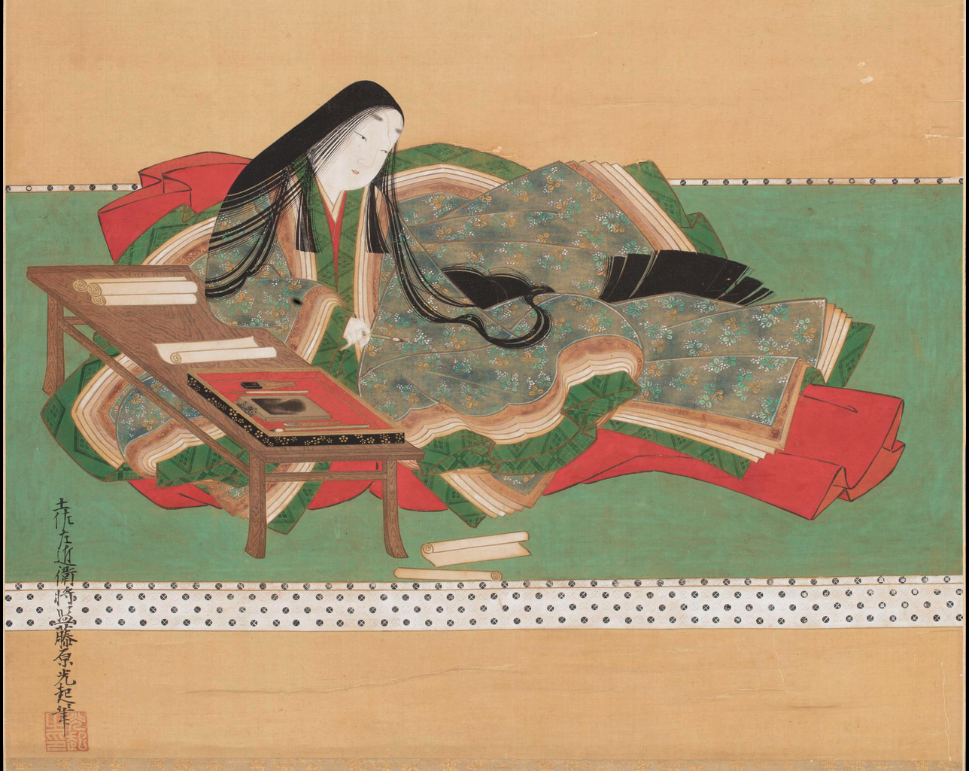
Murasaki Shikibu – Author of The Tale of Genji
Japanese aware had its origins in the Heian Era. During the Heian period (794–1185), writers—particularly court women—expressed the sentiment of mono no aware organically through diaries, tales, and waka poetry. This way of looking at life was exemplified by Japanese noblewoman and writer Murasaki Shikibu, a lady in waiting at the Japanese Imperial Court. Her masterpiece, The Tale of Genji, was written around 1000 – 1012 and follows the romantic and political life of Prince Genji. Historians consider it to be one of the world’s first novels ever written. In addition, it was one of the first psychological novels written.
About the Style of Heian Era Paintings
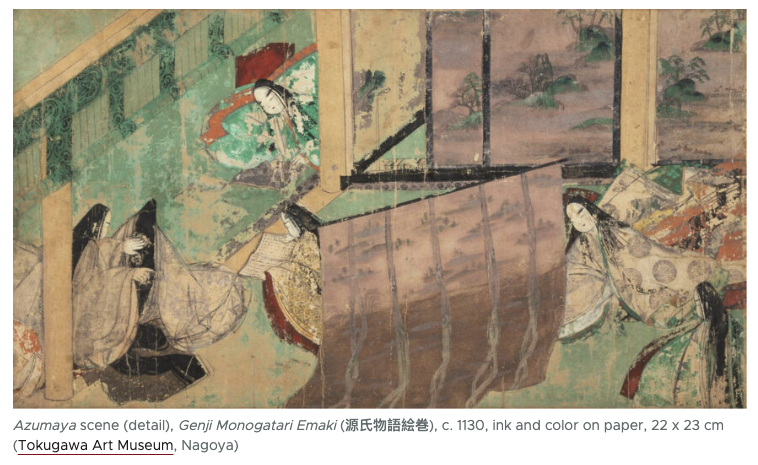
The Tale of Genji Scrolls were created in a Japanese art form done in the Yamato-e classical style of painting. This style showcased native Japanese subjects, landscape and literature instead of Chinese-inspired themes. It is known for its stylized facial features, muted color palettes and a perspective in Japanese art known as the “blown-off-roof” style or (fukinuki yatai.) Quite perceptively, this style removes roofs and ceilings to reveal emotional indoor palace scenes from an angled, hovering perspective. The muted colors were used to portray the melancholy transience of life capturing quiet sorrow and the beauty of passing time. Other key features were using alternating text and vibrant paintings, and a visual style known as hikime kagime, or “line for an eye, hook for a nose” facial features, which were very stylized. This was done as a way of putting more emphasis on rich garments and architecture rather than individual facial expressions.
Writing Style of The Tale of Genji
Another significant aspect of The Tale of Genji is that it was written mainly in hiragana, a phonetic writing script based on the sounds of the Japanese language. By contrast, kanji, which was a writing script using characters adopted from China, was predominantly reserved for use in official settings by highly-educated men well-versed in Chinese classics. Notably, hiragama was meant to be used by women and commoners. And, it was considered feminine, with a cursive script thought to be more graceful than kanji.
The Tale of Genji
Azumaya Scene from The Tale of Genji
The Tale of Genji is made up of 54 chapters and 800 waka, which are poems written to convey ideas on religion, nature, and the impermanence of life. Waka was the currency between lovers and a well-written waka enhanced a male courtier’s chances of success. These exchanges were imagined by Murasaki, the woman courtier who wrote The Tale of Genji, and woven into her masterpiece.
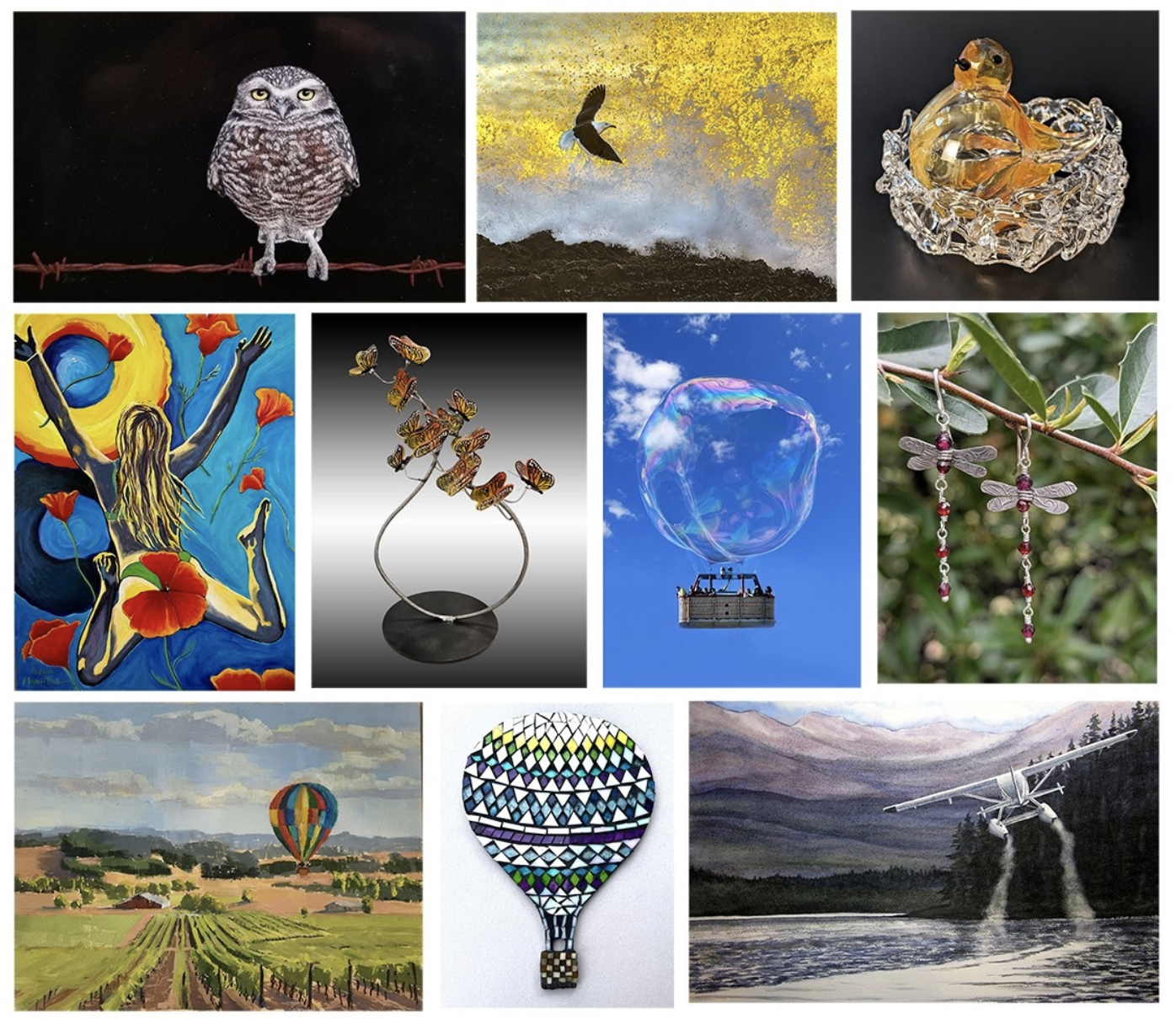
Although the title of this article is “Embracing Impermanence: How Fall Celebrates What We Cannot Keep” one way you can keep some of fall with you always is to celebrate the season with art. For the entire (but fleeting) month of October the Featured Wall at Auburn Old Town Gallery showcases the transient beauty of fall as captured in paintings, sculptures, ceramics, textiles, wood, and jewelry created by over 50 talented, local artists. Make sure to stop by and say “hi.”
Because they are fragile National Treasures, the original 12th-century pieces which make up The Tale of Genji (Genji Monogatari Emaki)) are only put on public display for brief annual windows. They are housed and divided between the Tokugawa Art Museum in Nagoya and the Goth Museum in Tokyo, Japan. They are kept in climate-controlled storage and are only briefly exhibited to the public for a limited time each year (traditionally for about a week in November) at the Tokugawa Art Museum or during special joint anniversary exhibitions.High-resolution digital archives and facsimile reproductions can instead be explored through resources like the Princeton University Art Museum or NYPL Digital Collections.
(Images courtesy of SmartHistory.org)YouTube History Video
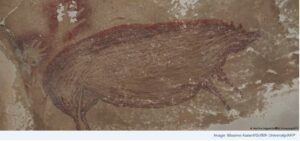
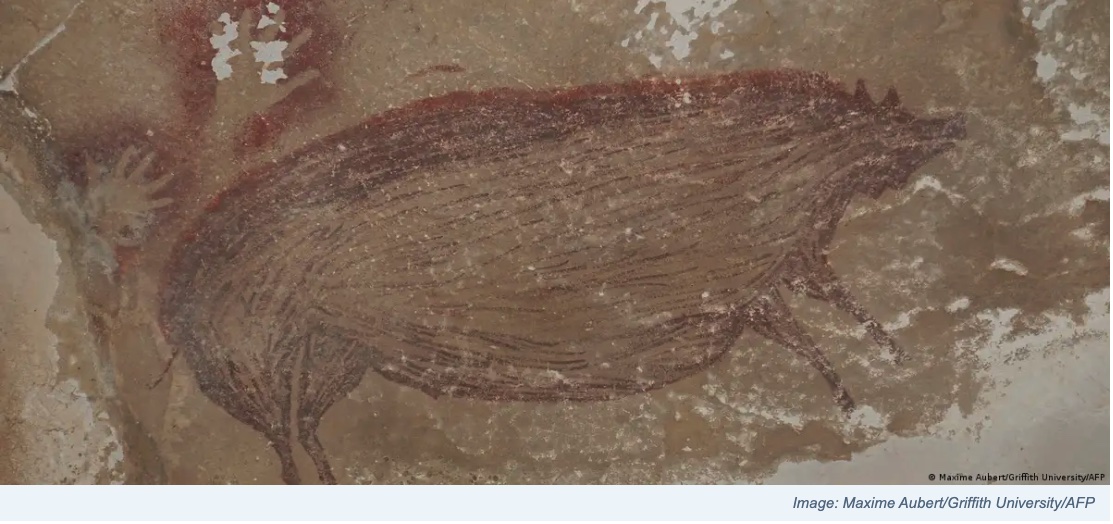
Since the dawn of human existence, animal forms on cave walls were the first art images ever recorded. In fact, the oldest cave drawing of an animal was recently discovered in Sulawesi, Indonesia and is a whopping 67,800 years old! This precedes European cave wall art by 15,000 years. From this we now know that ancient human creativity didn’t happen in a single place and it wasn’t just confined to ice age Europe. Instead, this uniquely human yearning to express ideas of behavior, storytelling, rituals, spiritual symbols, place and identity used animal forms on cave walls and was a world-wide phenomenon.
Today that yearning to express is more alive than ever, and it’s no wonder that animals still dominate artistic subject matter. They are the ultimate metaphor. Afterall, our fellow animals have been with us since the start. We share a planet together. We admire the wild, unselfconscious beauty of animals, which show us a mirror of what we ourselves once were before human self awareness became a thing. In our journey to the top of the food chain we used animals to get us to where we are now, as transportation, protection and sustenance. Without these fellow earthly inhabitants, we would not exist. Moreover, though we might believe that as humans we are separate from animals, we are, in fact, animals ourselves.
Wild Pig hand stencil found in a cave in Sulawesi, Indonesia (67,800 years old)
Animals and humans have an intimate, shared history. Through animals we see ourselves and they provide an anchor of our existence in time. The proof of their inextricable link to our existence is found in our exaltation of their form in artistic expression. In short, the animal was the first muse for aspiring caveman artists. Looking back in time, here’s how it rolls out:
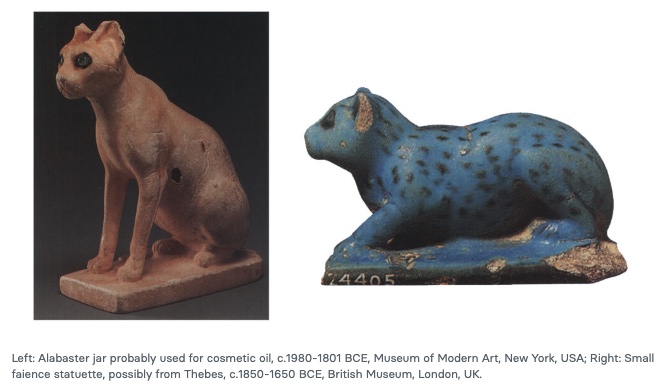
Prehistoric (up to 400 CE): (1) Cave paintings of animals and humans are found on cave walls as much as 68,000 years ago. (2) Ancient Egypt revered animals as gods with distinct symbolic traits and are seen in tomb paintings and sculptures. (3) Classical Antiquity: Greek and Roman art used animals in mythology to represent allegorical meaning.
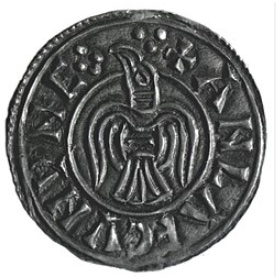
Ancient Egyptian CatsIron Age/Viking (400-1100CE): Northern European metalwork and jewelry featured stylized predators like wolves, eagles, boars and ravens.
Viking “Raven Penny”Medieval (1100 – 1400 CE): Religious symbols, like doves, are used to represent certain virtues alongside mythical beasts like griffins and unicorns. These animal renderings are largely whimsical and anatomically inaccurate.
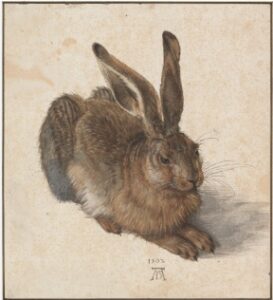
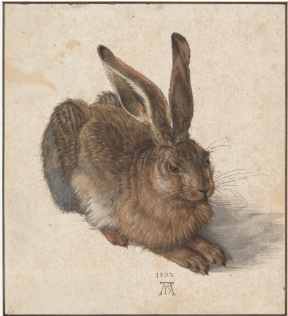
Renaissance (1400 – 1800s): The Age of Discovery and the rise of natural science led artists to meticulously document anatomy. Animals in art commonly represented human virtues, status and fidelity.
Albrecht Durer’s “Young Hare”19th Century to Today: 19th Century animal art is marked by accurate and powerful portrayals of farm animals and wildlife. Two examples are Rosa Bonheur with her accurate depiction of farm animals and James Audubon’s detailed watercolors of birds.
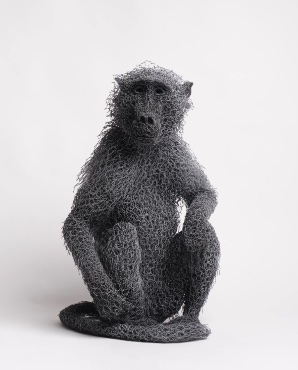
Today: Examples of today’s contemporary work include artists like Kendra Haste, who makes lifelike and life size sculptures of animals using galvanized wire mesh (Seated Baboon). Her work is marked by an emotional essence without sentimentality or anthropomorphism.
Kendra Haste, Seated Baboon
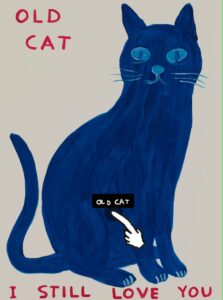
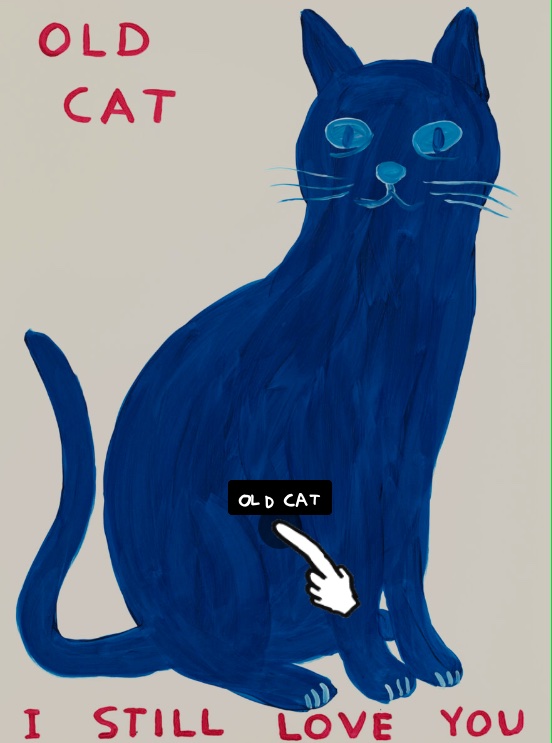
Likewise, another modern day example is printmaker David Shrigley, known for his signature crude line drawings, bittersweet humor and schoolboy lettering.
David Shrigley
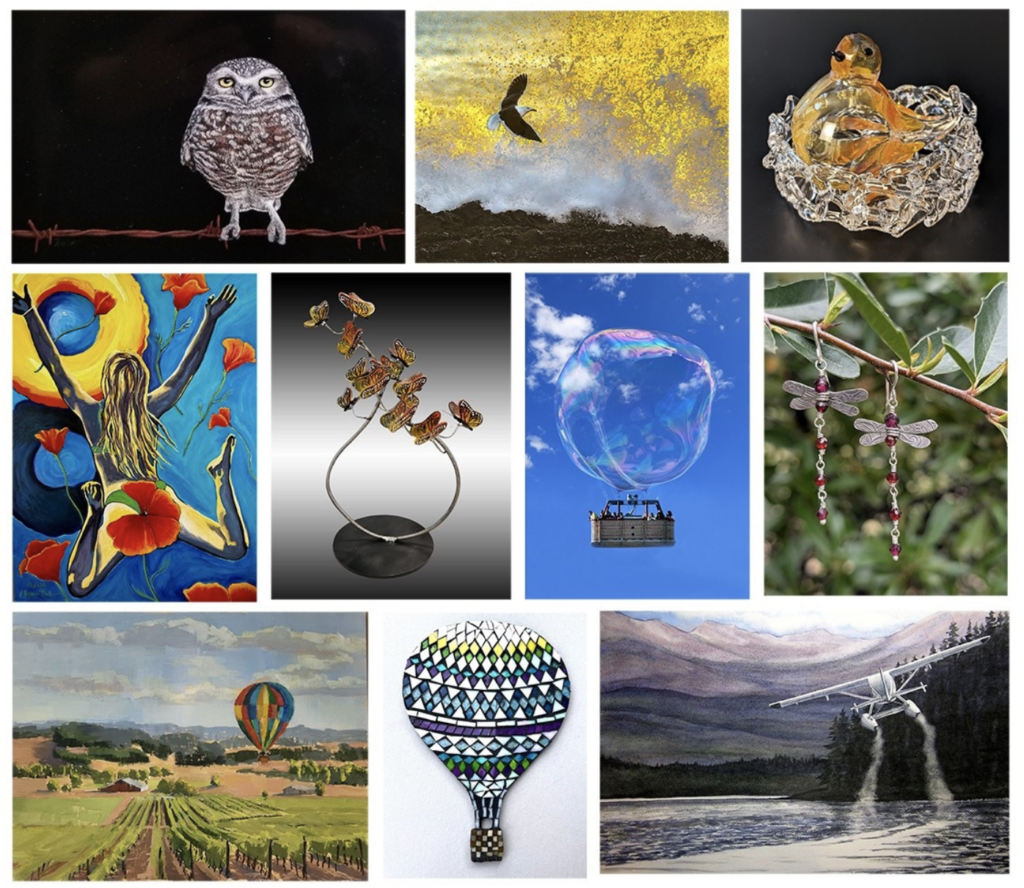
As you can see, animals have played a monumental role in art throughout the ages and are still a much used focus in today’s art. That being said, be sure to visit Auburn Old Town Gallery to take a look at this month’s Feature Wall which is all about—you guessed it—animal art. Now that you know a bit more about how animals and art are connected, you can have fun making up your own stories and distinctions about all the animal art on our Feature Wall, done up in a variety of mediums and styles by our talented local artists.
-Michelle Magnus Brown, August 2026
Open-minded, unconventional. Alternative, comfortable with ambiguity. These are just a few words and phrases that describe people who enjoy abstract art.
On the other hand, if you’ve ever approached a work of abstract art and thought, “My 5-year old could have done that,” you are not alone. Many people tend to think that abstract artists lack actual ability or talent. However, most if not all “abstract artists” began as traditional artists creating representational, “realistic” art. Artists understand that it’s only after you’ve mastered technique that you can dare to bend the rules. As Picasso famously quipped, “Learn the rules like a pro so you can break them like an artist.” Abstract art is decidedly a rule breaker and it is this free engagement with form, color, line and a child-like sense of discovery that make the best abstract art. At its core, abstract art is no slave to reality. Rather, it’s a leap into the uncertainty of not fully knowing and trusting your intuition as you go.
To gain a fuller understanding of abstract art it’s important to trace its history. Back in the day and before the advent of photography, an artist’s most important task was to make a painting or sculpture look realistic. These works were a snapshot in time, recording a realistic record of what was so. But once photography came along, the rules in art began to change. Following is an abbreviated history:
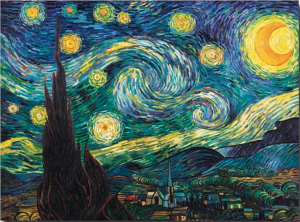
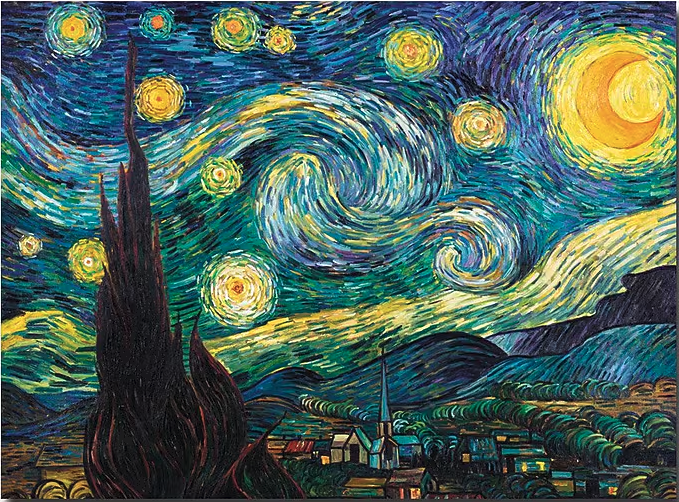
“Starry Night” by VanGoghLate 19th Century: Impressionism and Post-Impressionism (think Renoir, Monet; Van Gogh and Gauguin) begin to move the wheels to freer interpretation of “what is.” This is seen most acutely in novel ways of using color and brushstrokes to convey a different take on reality and express emotion through color.
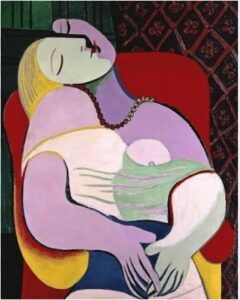
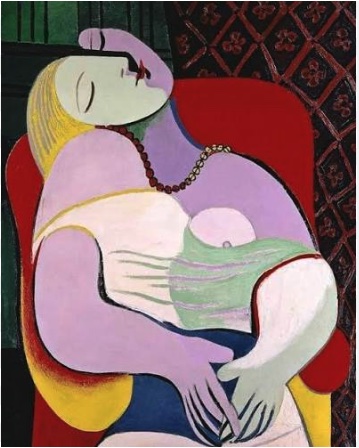
Picasso, “Last Night I Dreamt in Color”Cubism (1907-1912): Artists like Pablo Picasso and Georges Braque break objects into geometric shapes, challenging traditional perspective. (Keep in mind that Picasso was trained as a traditional painter and his early work is very realistic. He is clearly a skilled painter and adept with technique, yet he became famous for his daring cubism paintings.)
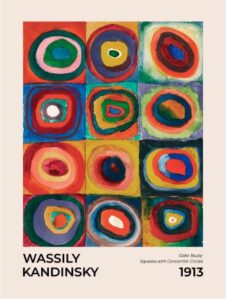
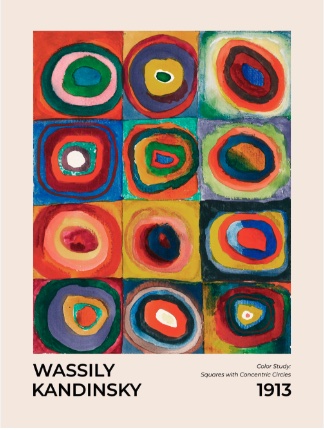
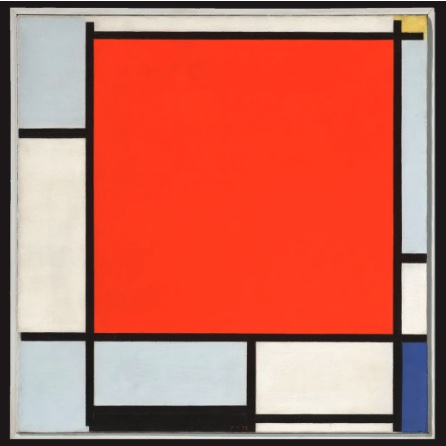
Pure Abstraction (1910-1914): Wassily Kandinsky (often called the Father of Abstract Art, along with Mondrian and Malevitch) paints some of the first completely non-objective works, linking color and form to inner emotion and music.
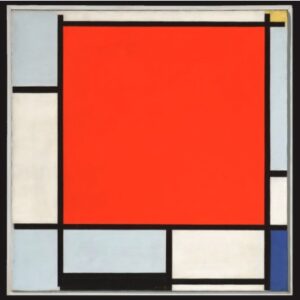
Piet Mondrian, “Composition C”Suprematism and De Stijl (a Dutch art movement): Kazimir Malevich in Russia and Piet Mondrian in the Netherlands use strict geometric purity and primary colors.
New York School (1940s-1950s): New York City takes over as the nexus for a post-war movement of abstraction and shifts global art to NYC. This leads to Abstract Expressionism……
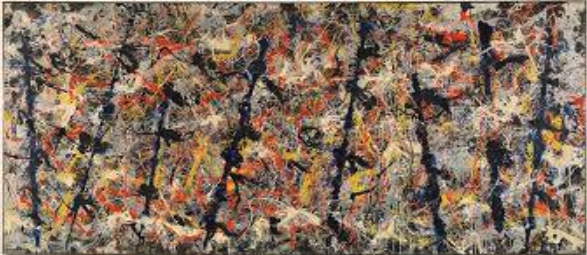
Abstract Expressionism: Includes “Action Painting”—think Jackson Pollock who created in chaotic, energetic drip techniques using buckets of house paint. And what’s called “Color Field” painting, i.e. Mark Rothko and Barnett Newman, who use large, flat areas of raw color to evoke deep emotional and spiritual responses.
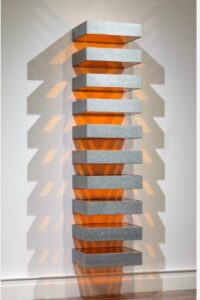
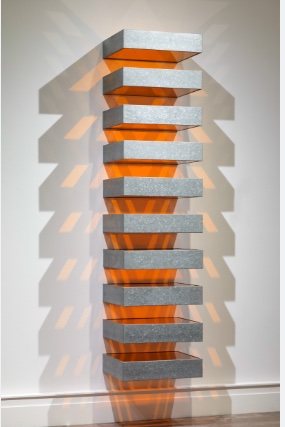
Jackson Pollock, “Blue Poles”Minimalism (1960s): Artists like Donald Judd strip art down to extreme geometric simplicity using industrial materials.
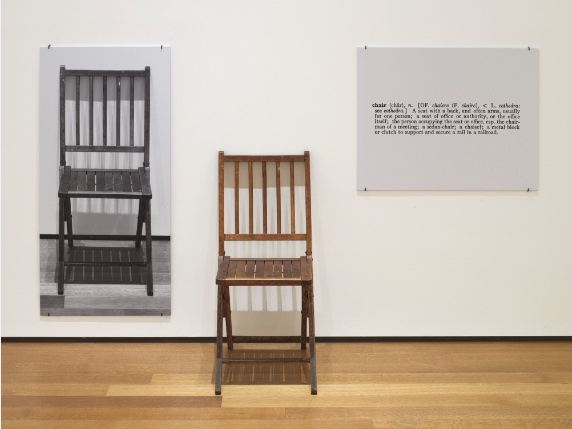
Donald Judd, “Untitled”Op Art and Conceptual Art: Artists experiment with optical illusion and ideas over the visual object.
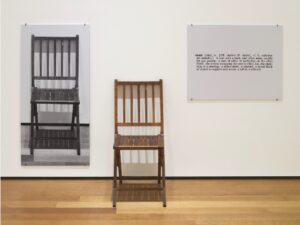
Joseph Kosuth, “One and Three Chairs”Contemporary Abstract Art: Today’s abstract art is often called contemporary abstraction, contemporary abstract art, or simply modern abstract art in casual speech. Unlike the fixed historical movements of the 20th century, it has no single governing rule and includes many mixing styles.
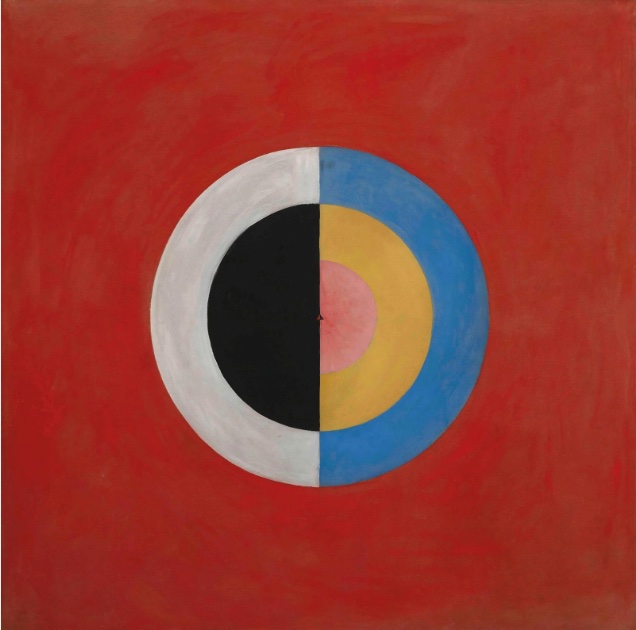
Ironically, the “fathers” of abstract art, who are said to be Kandinsky, Mondrian and Malevitch were actually preceded by a woman, so instead it might be more accurate to think “mother of abstract art!” Her name was Hilma af Klint, a Swedish painter who created a series of abstract paintings a full four years before the watercolor paintings of Kandinsky.
Hilma af Klint, “No. 17”
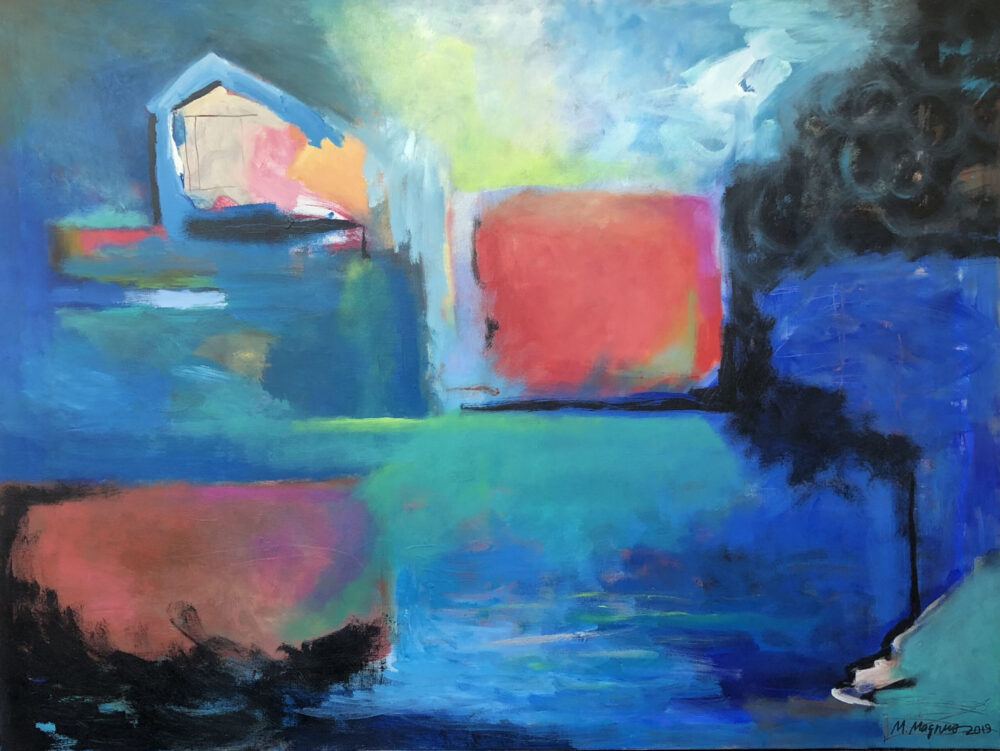
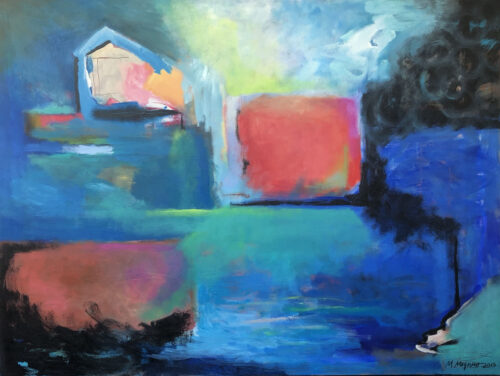
The greatest allure of abstract art is that it allows the viewer to make up their own mind about what is going on in the work much more so than with realistic or representational art. It is well known that we all see the same thing in different ways and nowhere is this truer than with an abstract image. I have done a number of abstract paintings myself and I love the freedom it gives me as a painter to communicate a feeling using pure color, composition, shapes and lines. And when the work is finished, I find it fascinating to hear responses from my viewers. In one work, titled “Bodega Bay #3” my husband says he sees a jet ski in the painting. This painting resonated with many, in different ways. During a wildfire in Sonoma County, while out of town, my colleague made sure to grab this painting off my office wall so it wasn’t in harm’s way, attesting to his connection to the painting. Still others have commented they feel a sense of home when they view this painting, which seems fitting as I was working in a real estate office at the time I painted it and had just purchased a home. The beauty of abstract art is that the work is up for interpretation—most importantly, your interpretation.
Michelle Magnus Brown, “Bodega Bay #3”
With all that said, make sure to stop by the gallery and have some fun coming up with your own interpretations. Our theme wall this month is called “Retro Abstractions,” and is dedicated entirely to abstract art. We invite you to come take a look and have fun making up your own story of each piece. Afterall, it’s your perspective that matters. And if abstract art isn’t for you, not to worry–we have 50+ regional talented artists in the gallery and everything from paintings, sculpture, ceramics, wood, metal, glass, repurposed clothing, cards, gifts……there is truly something for everyone at Auburn Old Town Gallery.
–Michelle Magnus Brown, August 2026
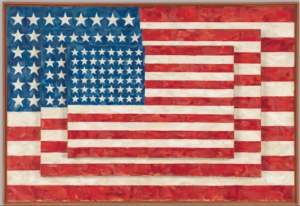
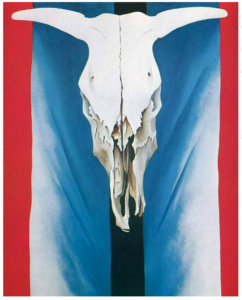
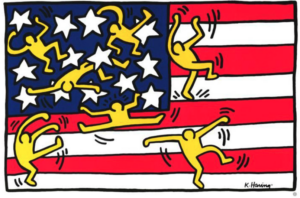
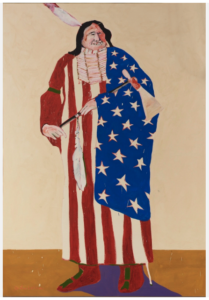
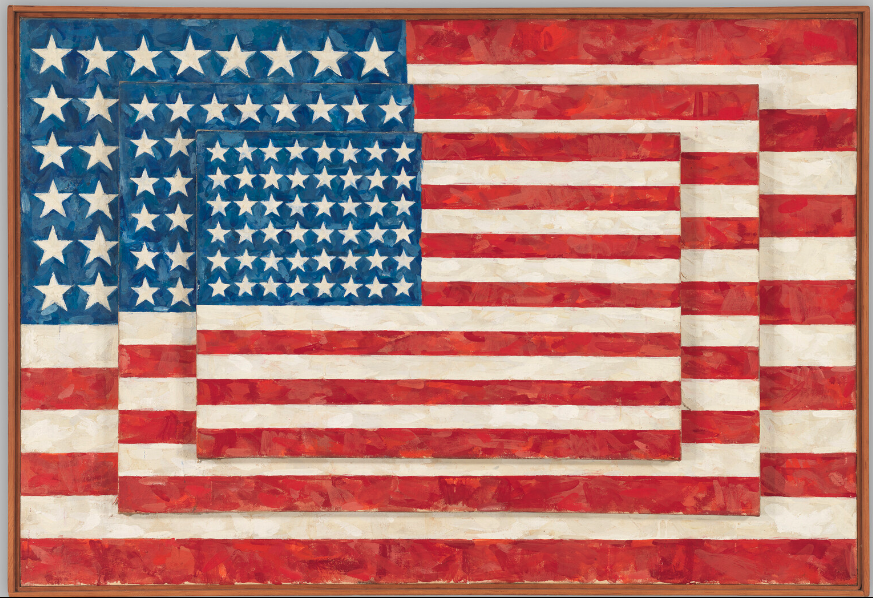
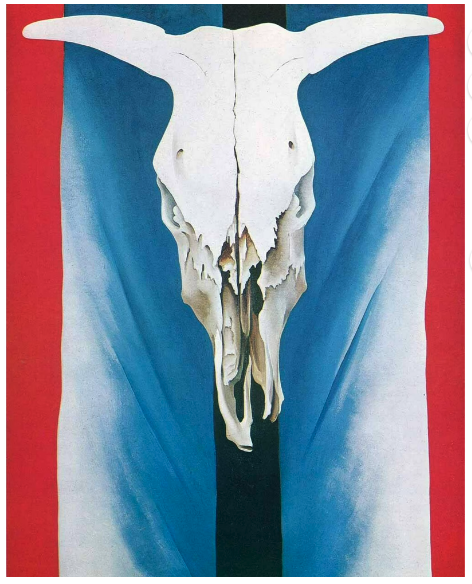
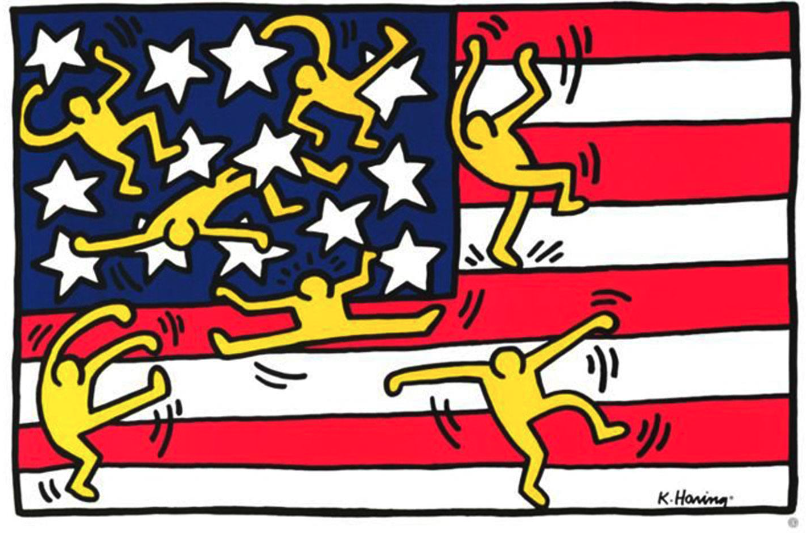
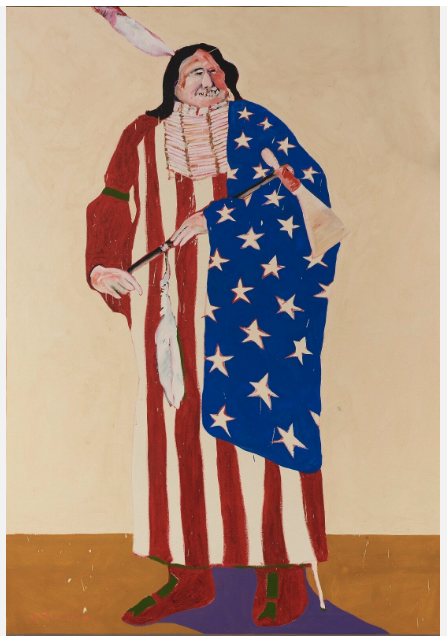
Artists are known for questioning the status quo with their work which is often the very reason art speaks to us. Whenever a spotlight is directed at an image it pulls that image into question just by virtue of focusing on it. However you choose to interpret a work of art, be it the Mona Lisa by Leonardo da Vinci or Campbell Soup Cans by Andy Warhol, the fact that it’s hanging framed on a wall invites you to stop and take notice. As we take the month of July to celebrate the 250th anniversary of the birth of our great nation, the United States, now is a perfect time to cast an eye on some artwork that feels decidedly American.
Jasper Johns, 3 Flags3 Flags by Jasper Johns3 Flags is an iconic pop art piece created in 1958 using stacked canvases painted with encaustic (hot wax that has pigment). This method created a textured, 3-dimensional piece. This piece brings into question whether Johns’ depiction expresses genuine patriotism or an ironic take on American nationalism during the Cold War era. Notice that the flag has only 48 stars, as Hawaii and Alaska were not yet part of the United States. To Johns the flag was a symbol that people “see but do not look.” By focusing with such intensity on the American flag the view is asked to confront the object itself instead of making assumptions as to its meaning. 3 Flags is on permanent display at the Whitney Museum of American Art in New York.
Cow Skull: Red, White and Blue by Georgia O’KeeffeGeorgia O’Keeffe, Cow’s Skull: Red, White & Blue
In this work, O’Keeffe isolates a single cow skull, highlighting its jagged edges, worn surfaces, and bleached color. To O’Keeffe, such bones represented the desert’s enduring beauty and the strength of the American spirit, which is alluded to in the striped background. In 1949 O’Keeffe settled permanently in New Mexico, where she lived until her death in 1986. On permanent display at The Metropolitan Musueum of Art in NYC. O’Keeffe died in Santa Fe at the age of 98.
Flag by Keith HarinKeith Harin, Flag
Keith Haring rose to prominence in 1980s New York within the East Village. He bridged the gap between the art world and the street, graffiting city subways and sidewalks before committing to a studio practice. Haring united the appeal of cartoons with the raw energy of a distinct pop-graffiti aesthetic that comprised energetic, boldly outlined figures against solid or patterned backdrops. Haring boldly engaged with social issues, especially after receiving an AIDS diagnosis in 1987. Keith Haring created his iconic Flag in 1988 as a promotional poster for NYC Ballet’s American Music Festival. Haring died in 1990 at the age of 31.
Fritz Scholder, American Flag IndianAmerican Flag Indian by Fritz Scholder
Fritz Scholder was of Luiseño heritage (a California Mission tribe). His bold depictions intentionally disrupted both white colonial myths and Native American art expectations, sparking decades of debate. His work challenged romanticized stereotypes of Native Americans. Scholder’s lithographs and paintings are highly regarded in American contemporary art and are housed in prestigious collections like the Museum of Fine Arts, Boston and the Crocker Art Museum. Scholder died in 2005 at the age of 67.
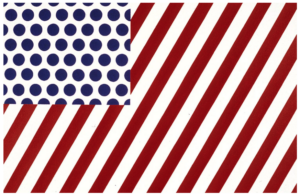
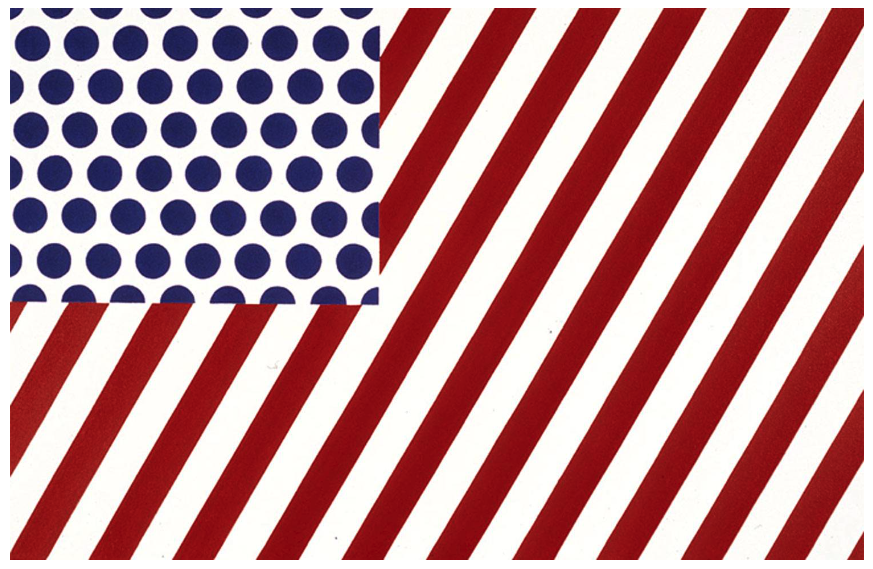
Roy Lichtenstein, The FlagForms in Space by Roy Lichtenstein
Lichtenstein was a leading figure of the Pop Art movement. Emerging in the early 1960s, Lichtenstein gained international recognition for works that employed bold outlines, flat colors, and his signature use of Ben-Day dots—a mechanical printing technique he meticulously replicated by hand. Through this approach, Lichtenstein challenged traditional distinctions between “high” art and popular culture, transforming seemingly banal source material into monumental, self-aware compositions. His work often explored themes of romance, war, consumerism, and art itself, frequently incorporating irony and detachment to comment on modern visual culture. Lichtenstein died from pneumonia in 1997 at the age of 73.
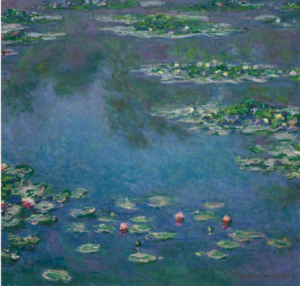
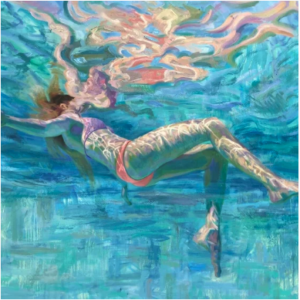
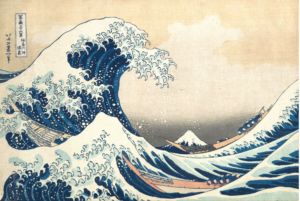
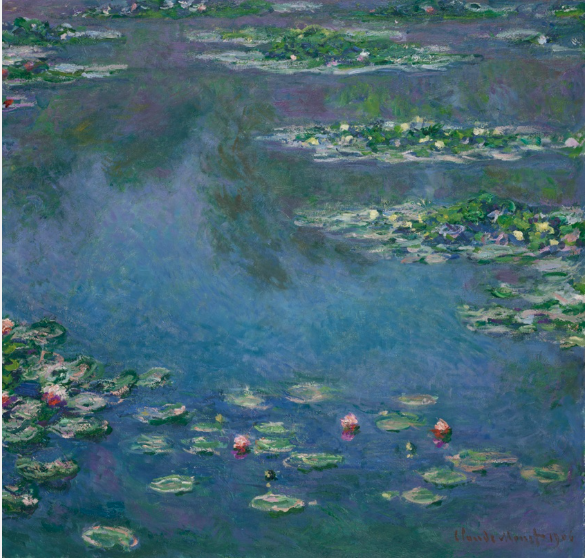
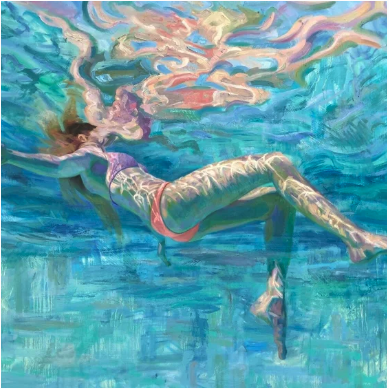
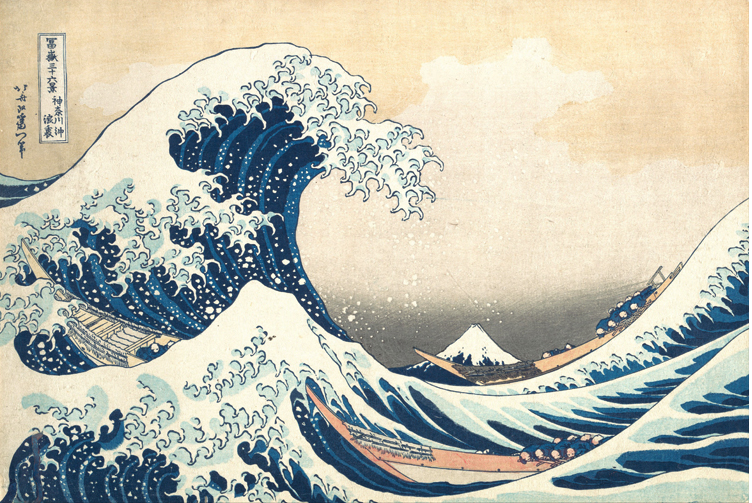
Our theme for June’s theme wall is focused on water. And it couldn’t come at a better time in the year than when the temps climb towards 100 degrees and we daydream of getting out on a lake or river. Water is a vital element and without it we wouldn’t be here. It’s also one of the most beautiful, complicated and elusive images to capture. Below are three very different artists who are famous for doing just that:
Most well-known today for his series of serene water lilies paintings, 19th-century Impressionist Claude Monet was a groundbreaking tour de force in the development of expressive art. Throughout his long life, which spanned the years between 1840 and 1926, Monet would progress from drawing amusing caricatures of friends to capturing the elusive nuances of natural scenes in various attitudes of light and color. Along with the other Impressionists, Monet’s aim in his painting was to capture reality and analyse the ever-changing nature of light and color. He recorded his surrounding faithfully, from the grime of a Paris railway station to the incandescent beauty of his later paintings based on the gardens he created at Giverny in north-eastern France. Frequently exhibited and successful during his lifetime, Monet’s fame and popularity soared in the second half of the 20th century when he became one of the world’s most famous painters and a source of inspiration for burgeoning groups of artists. By striving to translate his unique perception of the natural world directly to the canvas, Claude Monet was instrumental in forging an entirely new direction for the world of art.
“Ocean Embrace” by Isabel EmrichIsabel Emrich is a current day contemporary artist who works in an Expressionistic style that straddles both abstraction and figuration. Her brushwork is both strong and fluid – qualities that echo the nature of water, itself. With zeal, Emrich captures the ‘special effects’ water presents to the eye: chaotic refractions in multi-planar space, sparkling light effects, distorted shadows, rippled reflections, etc. – much of it in thick impasto paint,contrasted by passages of smooth vitality. Emrich forged her connection to the water growing up in Southern California. She loved the feeling of the cold salty ocean, and being under its big waves. Isabel offers a special debt of gratitude to her grandmother, who often took her up on the cliffs overlooking the water to plein-air paint. “Just paint what you see,” her grandmother would tell her, taking after the French Impressionists of yore.
“The Great Wave” by Katsushika HokusaiKatsushika Hokusai (1760–1849) was a Japanese ukiyo-e artist, painter, and printmaker, best known for his iconic woodblock print The Great Wave off Kanagawa (1831). Active during the Edo period, Hokusai produced a vast body of work that included landscapes, nature studies, and scenes of everyday life. His most famous series, Thirty-Six Views of Mount Fuji, reflects his fascination with the mountain and showcases his innovative use of perspective and bold composition. Hokusai had a profound influence on both Japanese art and Western artists, particularly during the Japonisme movement in 19th-century Europe.
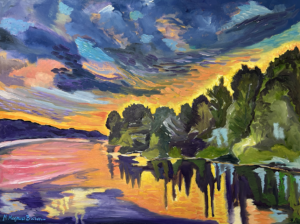
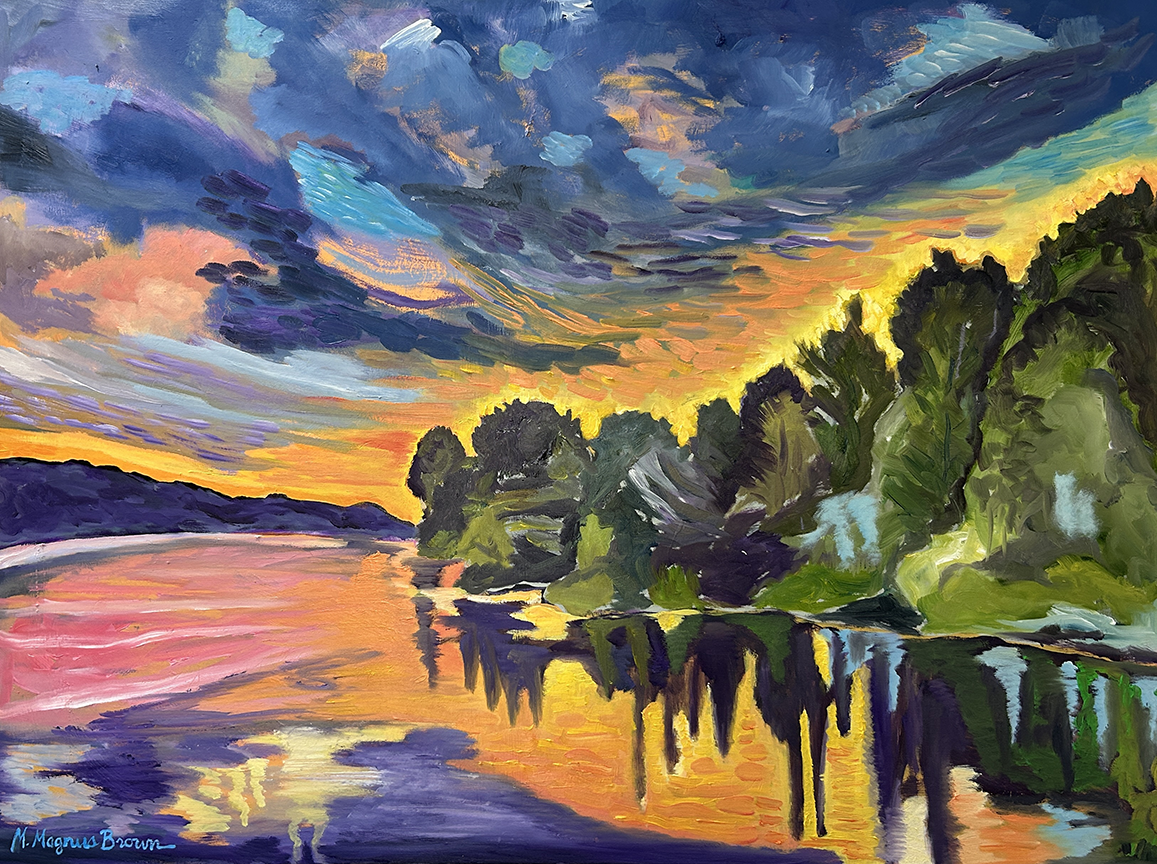
“Sunset on the American” by Michelle Magnus Brown
The spring equinox just had its moment on March 20 and as we head into April our thoughts turn to new beginnings. It’s easy to see why nature and the magnificent beauty of earth take center stage as the spring days roll out.
It makes perfect sense that earth and art have always had a deep, long-standing relationship. Everything we know and everything that impacts our daily lives–from computer chips to a bouquet of flowers to eating a donut to creating a painting–has, as its source, the earth. From the pyramids of Egypt to da Vinci’s painting of the Mona Lisa all art originates from our connection with planet earth.
In 1969 a massive oil spill off the coast of southern California inspired the first annual Earth Day on April 22, 1970. Today Earth Day is recognized as the launch of the environmental movement and observed in nearly 200 countries around the world.
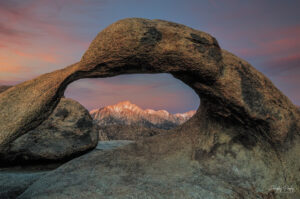
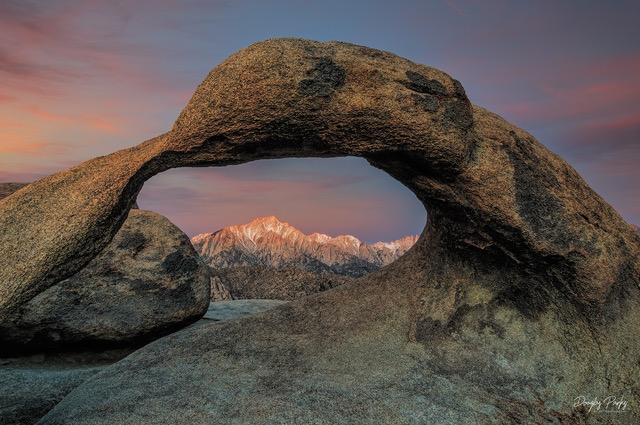
Photography by Doug Parks
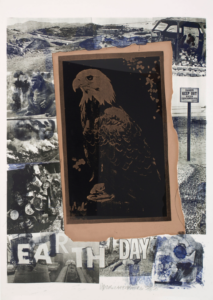
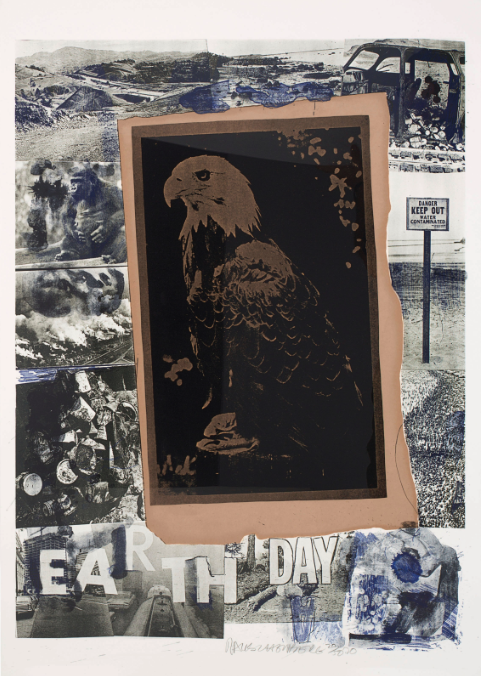
Not surprisingly, artists jumped in to express the idea of Earth Day through their art. Robert Rauschenberg designed the first Earth Day poster to benefit the movement. It used the bald eagle as the dominant image, a bird that almost became extinct due to the use of DDT pesticides that polluted waterways. DDT was banned in 1972 as a direct result of Earth Day. Today the rebound of bald eagle populations and unpolluted waterways show how Earth Day has done its job.
First poster for Earth Day by Robert Rauschenberg, “Earth Day April 22”
Rauschenberg’s “Earth Day 22 April” poster was published in an edition of 10,300 by Castelli Graphics, New York. Using the bald eagle as the dominant image, the artist symbolically placed the United States at the center of a global problem. Muted and muddy tones depicting environmental decay surround the national bird: polluted cities, contaminated waters, junkyards littered with debris, landscapes scarred by highways and deforestation, and the gorilla, another endangered animal. The safekeeping of the environment and the notion of individual responsibility for the welfare of life on earth was a longstanding concern of Rauschenberg, and this notion would inform his art and activism throughout his life. The poster designed for the inaugural Earth Day was one of many he would create to raise funds for the myriad social causes that were important to him.
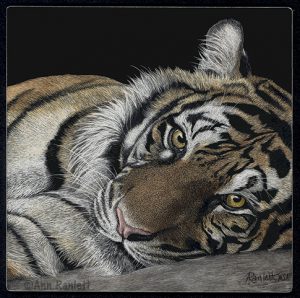
“Tiger” by Ann Ranlett
People speak of “saving the earth” as an aspiration. The truth is that the earth doesn’t need our help. The earth will go on doing its thing long after we’re gone. The dinosaurs are said to have inhabited earth for 180 million years (give or take) while modern humans have been around for a mere 300,000 years. We are but guests on the planet, existing in a moment of time, perhaps. Our existence relies on a climate that can provide clean air, clean water and grow plants and animals vital to our survival.
It’s unfortunate that both Earth Day and the EPA have become mired in political dissention. Most of us can agree that protecting clean air and water for the benefit of all living beings should not be a political issue. We should all be able to get behind protections that keep our planet healthy and livable. Individual responsibility is truly at the core of Earth Day.
Repurposed hand bags by Yvonne Warren
As you enjoy the new beginnings of yet another beautiful spring make it a point to stop by Auburn Old Town Gallery. There you will find unique pieces of art inspired by our natural world, all of them made by talented local artists. Indeed, the beauty and promise of our earth is alive and well in Auburn Old Town Gallery. And we look forward to seeing you!
“Everyday is Earth Day.” -Unknown
With AI breathing down our necks it feels more important than ever to surround ourselves with things that are indisputably human and personal.That’s where art comes in.
True, it might be easier and cheaper to head over to Home Goods for some quick, mass-produced art to throw on your walls. And it’s certainly faster to click on your Amazon app to grab a quick gift. But will that give you lifelong special memories of the moment you saw it and the way it spoke to you? What is the memory and the meaning that comes with the art that you will look at every single day? Who made it? Where did it come from? What kind of energy is it exuding into the space you call home? Fine art is real art, the way a gourmet meal at a fine restaurant is a world away from a trip to McDonalds.
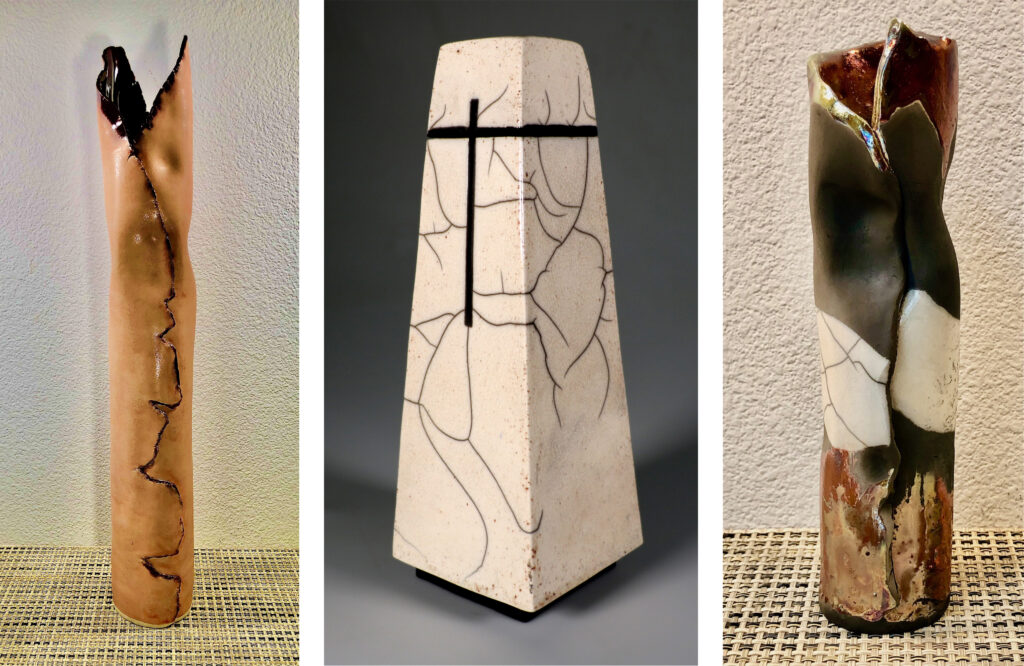
If you are in the pursuit of the personal consider adding art pieces created by local artists such as hand-thrown ceramic dishware, original paintings, hand-dyed textiles, and unique metal pieces for the garden. And don’t forget to include framed pictures that your children or grandchildren made and (of course) passed-down family heirlooms. These are all ways to make your home a sanctuary that reflects your unique taste that makes your home a personal and special experience.
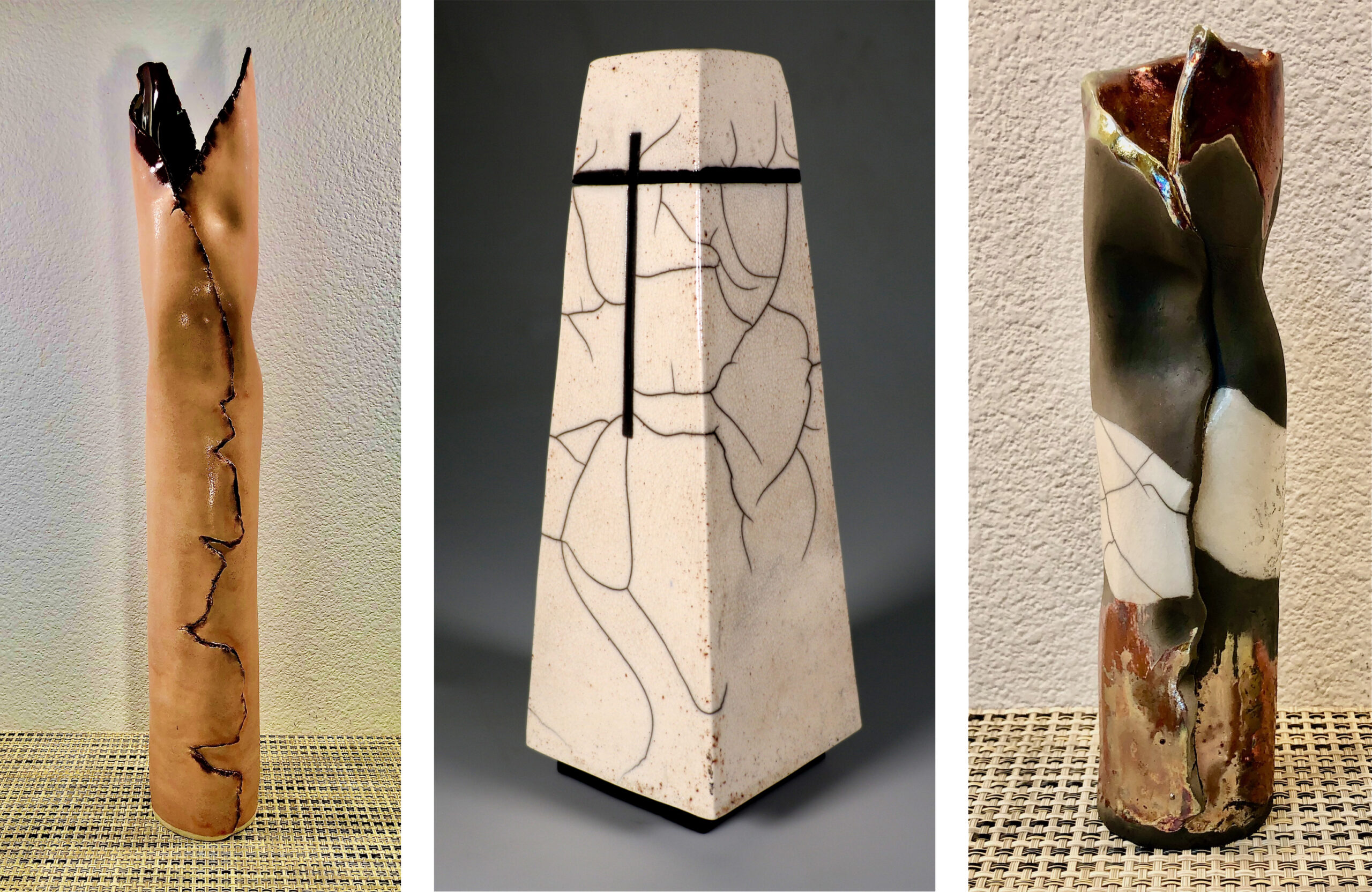
Ceramic works by AOTG Artist Pam Kinzie
So if you are looking to add some amazing art pieces to your home look no further than Auburn Old Town Gallery. The gallery has been around for 30 years and features approximately 50 local artists. It’s a place you can count on for art pieces that are crafted with the utmost skill and are undeniably personal and unique…..like you. It’s a place where you can find that perfect gift that you will never find at Amazon or Walmart. And when that original, unique, chosen piece of art finally gets to its forever home it will carry the memory of who you were with and what you were doing and why you were there and who you were thinking of.
Take a look at this month’s Theme Wall: The Air We Share (Displayed through the month of March):

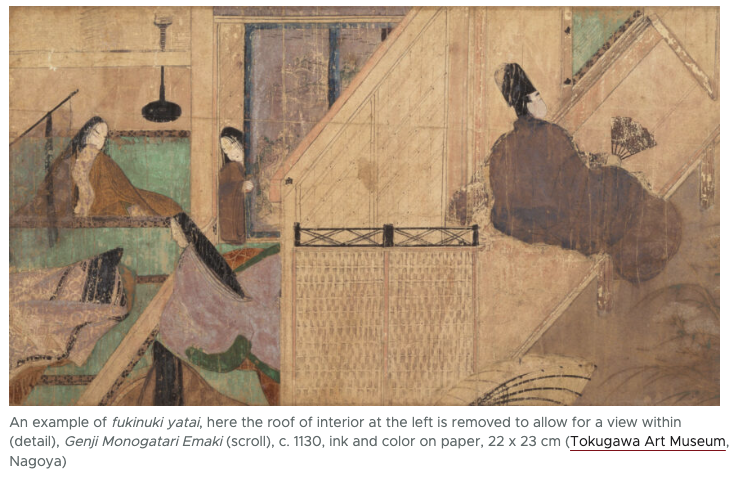 The Tale of Genji Scrolls were created in a Japanese art form done in the Yamato-e classical style of painting. This style showcased native Japanese subjects, landscape and literature instead of Chinese-inspired themes. It is known for its stylized facial features, muted color palettes and a perspective in Japanese art known as the “blown-off-roof” style or (fukinuki yatai.) Quite perceptively, this style removes roofs and ceilings to reveal emotional indoor palace scenes from an angled, hovering perspective. The muted colors were used to portray the melancholy transience of life capturing quiet sorrow and the beauty of passing time. Other key features were using alternating text and vibrant paintings, and a visual style known as hikime kagime, or “line for an eye, hook for a nose” facial features, which were very stylized. This was done as a way of putting more emphasis on rich garments and architecture rather than individual facial expressions.
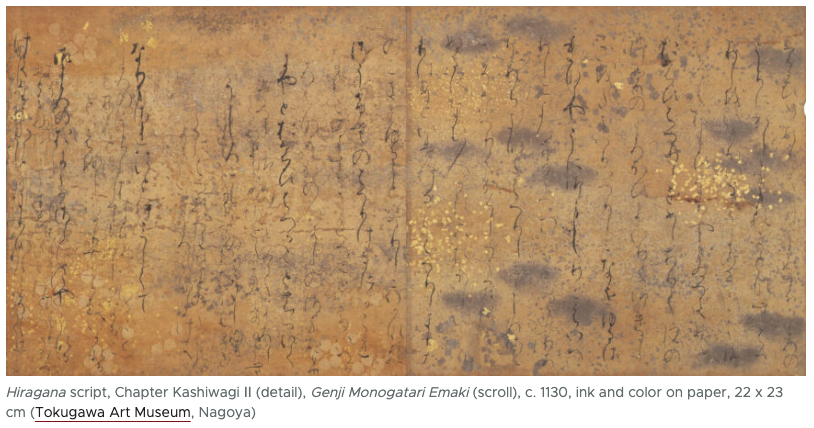 Another significant aspect of The Tale of Genji is that it was written mainly in hiragana, a phonetic writing script based on the sounds of the Japanese language. By contrast, kanji, which was a writing script using characters adopted from China, was predominantly reserved for use in official settings by highly-educated men well-versed in Chinese classics. Notably, hiragama was meant to be used by women and commoners. And, it was considered feminine, with a cursive script thought to be more graceful than kanji.