
EMBRACING IMPERMANENCE:
How Fall Celebrates What We Cannot Keep
There is something indescribably and undeniably bittersweet about fall. Indeed, this reaction to autumn seems to be a universal feeling in many cultures around the world. Arguably no other culture embodies this melancholy beauty better than Japan. They even have a name for it: mono no aware (Mono = thing, No=of and Aware=sadness). This word is used to describe the traditional Japanese idiom that translates to “the pathos of things” (“pathos” being a quality in art, writing or life that evokes feelings of sadness, pity or sympathy.) At its core, mono no aware celebrates the bittersweet awareness of impermanence that fall, more than any other season, evokes. Indeed, the shortness of this season is the reason for its particular sweetness.
Mono No Aware
It’s interesting that our English word “aware” and the actual Japanese word “aware” (pronounced “ah-wah-RAY”) have the same spelling and even similar meanings. The Japanese version of the word translates roughly to “pathos,” “deep feeling,” “sensitivity,” or a gentle, bittersweet sadness. It was originally used as an exclamation—similar to saying “ah,” “oh,” or “wow” when struck by the beauty of something. Similarly, the definition of the English word “aware” is an adjective that means having knowledge, understanding, or realization of something. However, the significant difference between the two is the emphasis on psychological feeling and connection that the Japanese meaning of aware embodies. By contrast the English version of this word seems more concerned with the somewhat sterile definition of knowing something as opposed to feeling it.
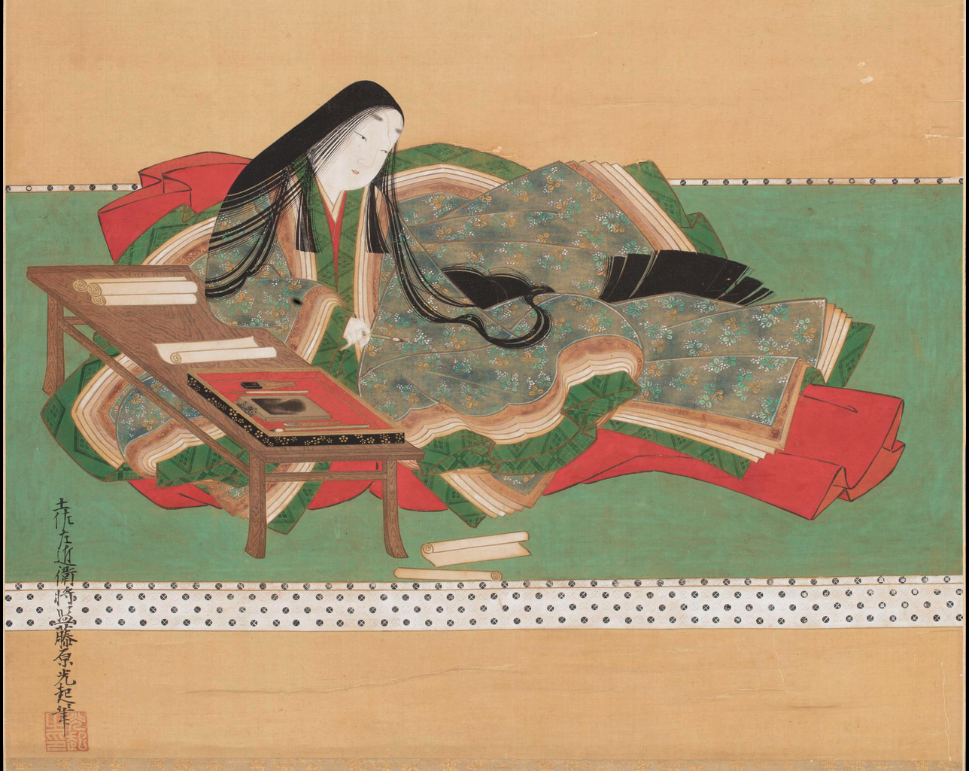
Murasaki Shikibu – Author of The Tale of Genji
Japanese aware had its origins in the Heian Era. During the Heian period (794–1185), writers—particularly court women—expressed the sentiment of mono no aware organically through diaries, tales, and waka poetry. This way of looking at life was exemplified by Japanese noblewoman and writer Murasaki Shikibu, a lady in waiting at the Japanese Imperial Court. Her masterpiece, The Tale of Genji, was written around 1000 – 1012 and follows the romantic and political life of Prince Genji. Historians consider it to be one of the world’s first novels ever written. In addition, it was one of the first psychological novels written.
About the Style of Heian Era Paintings
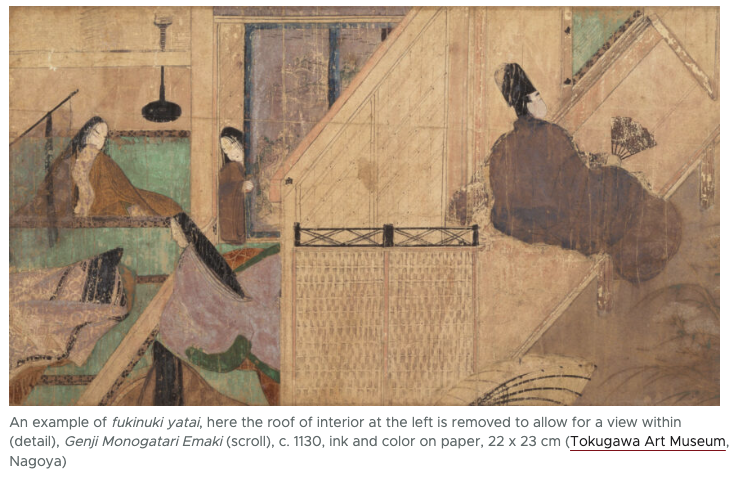
The Tale of Genji Scrolls were created in a Japanese art form done in the Yamato-e classical style of painting. This style showcased native Japanese subjects, landscape and literature instead of Chinese-inspired themes. It is known for its stylized facial features, muted color palettes and a perspective in Japanese art known as the “blown-off-roof” style or (fukinuki yatai.) Quite perceptively, this style removes roofs and ceilings to reveal emotional indoor palace scenes from an angled, hovering perspective. The muted colors were used to portray the melancholy transience of life capturing quiet sorrow and the beauty of passing time. Other key features were using alternating text and vibrant paintings, and a visual style known as hikime kagime, or “line for an eye, hook for a nose” facial features, which were very stylized. This was done as a way of putting more emphasis on rich garments and architecture rather than individual facial expressions.
Writing Style of The Tale of Genji
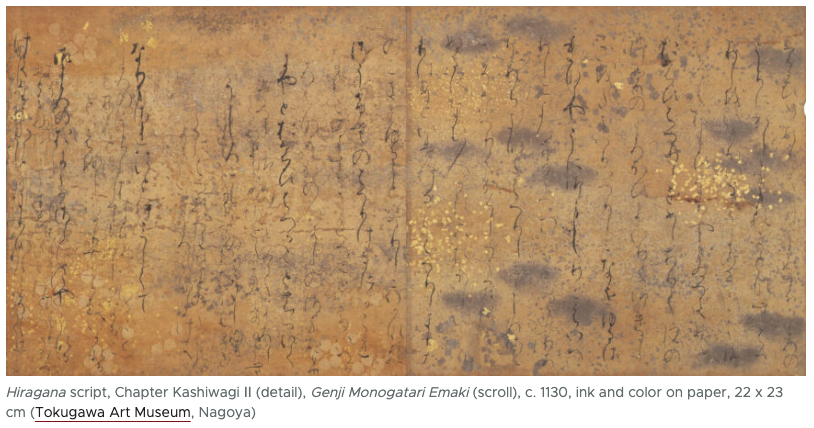
Another significant aspect of The Tale of Genji is that it was written mainly in hiragana, a phonetic writing script based on the sounds of the Japanese language. By contrast, kanji, which was a writing script using characters adopted from China, was predominantly reserved for use in official settings by highly-educated men well-versed in Chinese classics. Notably, hiragama was meant to be used by women and commoners. And, it was considered feminine, with a cursive script thought to be more graceful than kanji.
The Tale of Genji
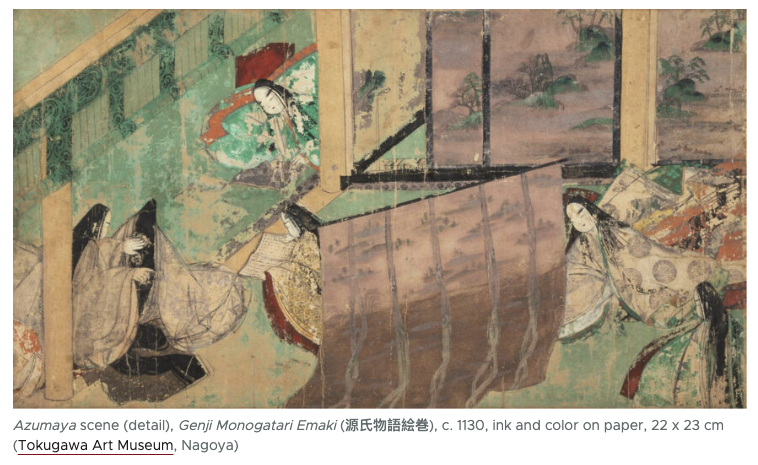
The Tale of Genji is made up of 54 chapters and 800 waka, which are poems written to convey ideas on religion, nature, and the impermanence of life. Waka was the currency between lovers and a well-written waka enhanced a male courtier’s chances of success. These exchanges were imagined by Murasaki, the woman courtier who wrote The Tale of Genji, and woven into her masterpiece.
Although the title of this article is “Embracing Impermanence: How Fall Celebrates What We Cannot Keep” one way you can keep some of fall with you always is to celebrate the season with art. For the entire (but fleeting) month of October the Featured Wall at Auburn Old Town Gallery showcases the transient beauty of fall as captured in paintings, sculptures, ceramics, textiles, wood, and jewelry created by over 50 talented, local artists. Make sure to stop by and say “hi.”
Because they are fragile National Treasures, the original 12th-century pieces which make up The Tale of Genji (Genji Monogatari Emaki)) are only put on public display for brief annual windows. They are housed and divided between the Tokugawa Art Museum in Nagoya and the Goth Museum in Tokyo, Japan. They are kept in climate-controlled storage and are only briefly exhibited to the public for a limited time each year (traditionally for about a week in November) at the Tokugawa Art Museum or during special joint anniversary exhibitions.High-resolution digital archives and facsimile reproductions can instead be explored through resources like the Princeton University Art Museum or NYPL Digital Collections.
(Images courtesy of SmartHistory.org)