
Artists are known for questioning the status quo with their work which is often the very reason art speaks to us. Whenever a spotlight is directed at an image it pulls that image into question just by virtue of focusing on it. However you choose to interpret a work of art, be it the Mona Lisa by Leonardo da Vinci or Campbell Soup Cans by Andy Warhol, the fact that it’s hanging framed on a wall invites you to stop and take notice. As we take the month of July to celebrate the 250th anniversary of the birth of our great nation, the United States, now is a perfect time to cast an eye on some artwork that feels decidedly American.
Jasper Johns, 3 Flags
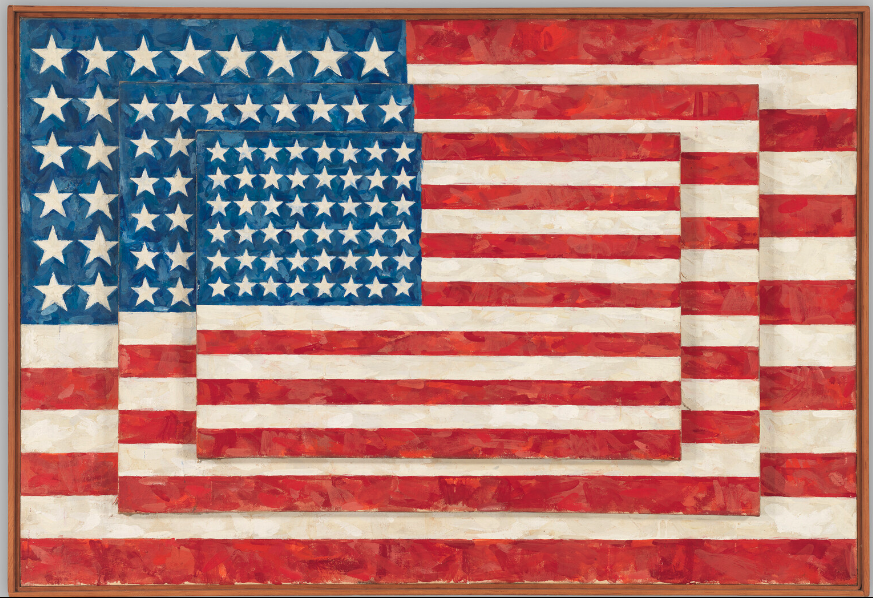
3 Flags is an iconic pop art piece created in 1958 using stacked canvases painted with encaustic (hot wax that has pigment). This method created a textured, 3-dimensional piece. This piece brings into question whether Johns’ depiction expresses genuine patriotism or an ironic take on American nationalism during the Cold War era. Notice that the flag has only 48 stars, as Hawaii and Alaska were not yet part of the United States. To Johns the flag was a symbol that people “see but do not look.” By focusing with such intensity on the American flag the view is asked to confront the object itself instead of making assumptions as to its meaning. 3 Flags is on permanent display at the Whitney Museum of American Art in New York.
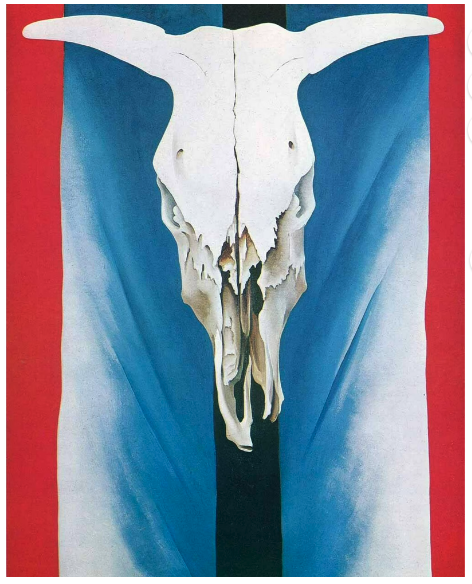
Georgia O’Keeffe, Cow’s Skull: Red, White & Blue
In this work, O’Keeffe isolates a single cow skull, highlighting its jagged edges, worn surfaces, and bleached color. To O’Keeffe, such bones represented the desert’s enduring beauty and the strength of the American spirit, which is alluded to in the striped background. In 1949 O’Keeffe settled permanently in New Mexico, where she lived until her death in 1986. On permanent display at The Metropolitan Musueum of Art in NYC. O’Keeffe died in Santa Fe at the age of 98.
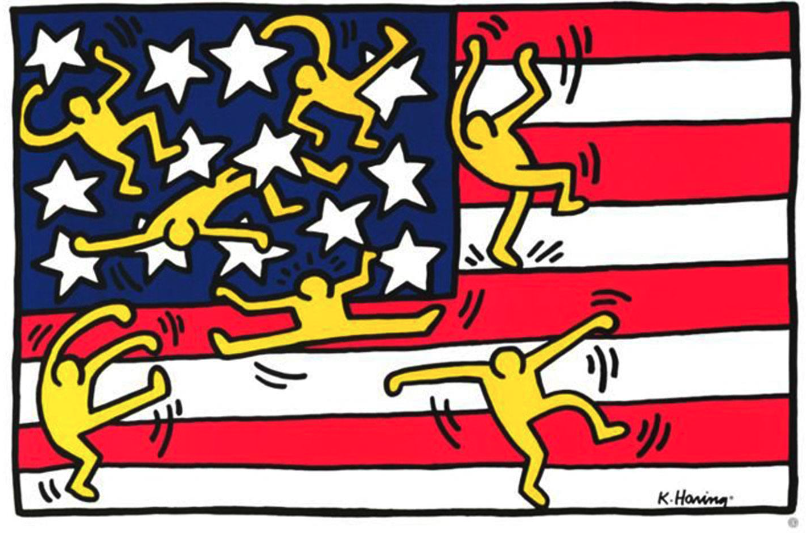
Keith Harin, Flag
Keith Haring rose to prominence in 1980s New York within the East Village. He bridged the gap between the art world and the street, graffiting city subways and sidewalks before committing to a studio practice. Haring united the appeal of cartoons with the raw energy of a distinct pop-graffiti aesthetic that comprised energetic, boldly outlined figures against solid or patterned backdrops. Haring boldly engaged with social issues, especially after receiving an AIDS diagnosis in 1987. Keith Haring created his iconic Flag in 1988 as a promotional poster for NYC Ballet’s American Music Festival. Haring died in 1990 at the age of 31.
Fritz Scholder, American Flag Indian
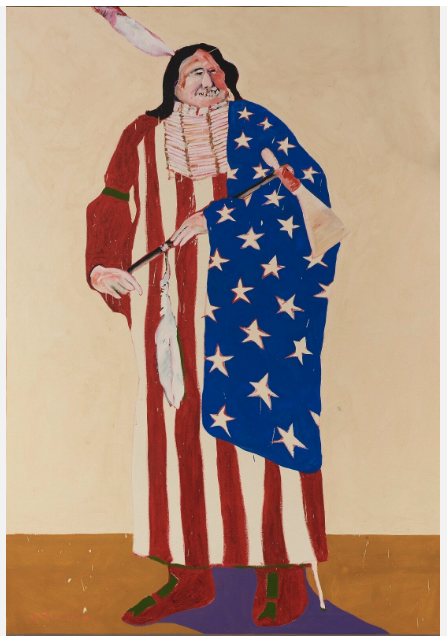
Fritz Scholder was of Luiseño heritage (a California Mission tribe). His bold depictions intentionally disrupted both white colonial myths and Native American art expectations, sparking decades of debate. His work challenged romanticized stereotypes of Native Americans. Scholder’s lithographs and paintings are highly regarded in American contemporary art and are housed in prestigious collections like the Museum of Fine Arts, Boston and the Crocker Art Museum. Scholder died in 2005 at the age of 67.
Roy Lichtenstein, The Flag
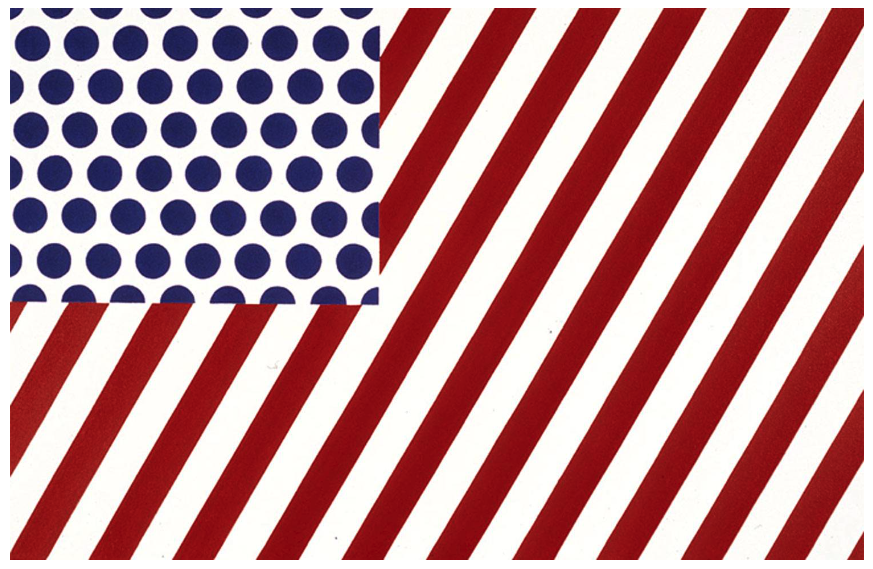
Lichtenstein was a leading figure of the Pop Art movement. Emerging in the early 1960s, Lichtenstein gained international recognition for works that employed bold outlines, flat colors, and his signature use of Ben-Day dots—a mechanical printing technique he meticulously replicated by hand. Through this approach, Lichtenstein challenged traditional distinctions between “high” art and popular culture, transforming seemingly banal source material into monumental, self-aware compositions. His work often explored themes of romance, war, consumerism, and art itself, frequently incorporating irony and detachment to comment on modern visual culture. Lichtenstein died from pneumonia in 1997 at the age of 73.